Permanent exhibition: The tree, the architect and the garden
Fabiani’s realised utopia
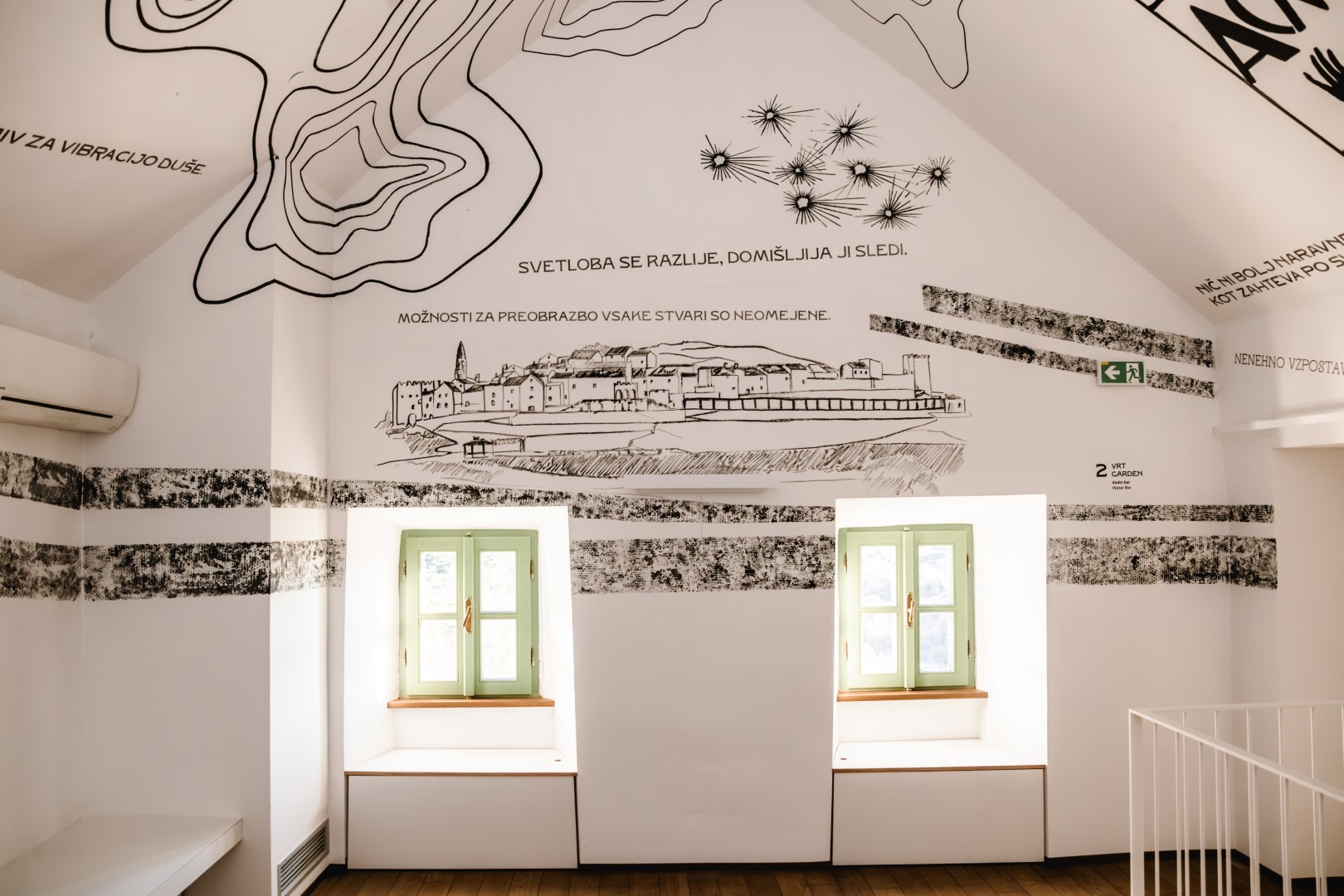
The permanent exhibition on the first and second floors of Natalija’s House is dedicated to Villa Ferrari and its garden, the work of the architect Max Fabiani. The architect who designed the Urania, the most visited building in Vienna before the First World War, returned to the Karst. It is in Štanjel that we can see at close hand his guiding principles, which form a bridge between tradition and modernism, between European cities and rural Slovenia, between nature and man. An interdisciplinary team of more than 30 creatives has explored and interpreted Fabiani’s garden of ideas.
THE TREE
Max Fabiani’s story begins with a tree. With the green dome of a more than 500-year-old mulberry tree on the Fabiani estate that so captivated his mother when she first came from Trieste to the Karst for convalescence. It was here that she met her future husband, Antonio Fabiani, whose estate she would manage for more than 80 years. They had fourteen children. The tree still grows today in the garden of Villa Fabiani.
THE ARCHITECT
The stories on the first floor and the wall-and-ceiling painting at the top of the house reveal the personal story of Max Fabiani. His career unfolds almost cinematically: from student to respected professor at the Vienna University of Technology, from architect in the great cities of the Empire to urban planner in smaller centres in post-First World War Slovenia. In the end, rather than Vienna, he chose the challenge of post-war reconstruction of the devastated Karst, Goriška and Soča Valley regions. The renovation of Štanjel Castle was one of the first examples in Europe of the transformation of a former elite residence into a centre of everyday life. On the other side of the settlement, he persuaded his nephew from Trieste to buy houses and fragmented plots of land, which he combined to create Villa Ferrari and its garden.
THE GARDEN
The Ferrari Garden is not only Fabiani’s best-known work in Štanjel, it is also his garden of creativity, which continues to offer relaxation to residents and visitors, delight children from the local nursery, energise yoga practitioners and accompany couples into their shared future. At the same time, it is a utopia of the future, demonstrating that it is possible to create a self-sufficient system that outwardly functions as a social space while inwardly integrating all the essential functions of community life, from water collection to food production and waste processing.
At its heart are water, the source of life, the Karst landscape to which the architect adapts, and an eclectic blend of stylistic influences. Through photographs, personal accounts and contemporary footage, you will gain a sense of how the Ferrari Garden is Štanjel’s heartbeat.
Location:
First and second floor of Natalija’s House
Opening hours
SUMMER SCHEDULE
Monday: Closed (except for pre-booked groups)
Tuesday–Friday: 9:00–17:00
Saturday, Sunday and public holidays: 9:00–18:00
WINTER SCHEDULE
Monday–Wednesday: Closed (except for pre-booked groups)
Thursday–Sunday and public holidays: 9:00–16:00
Contact
Natalija’s House Visitor Centre
+386 41 383 986
info@visitstanjel.si


